When (or if, depending on your point of view) Global Warming begins to hit us all, there's one thing nobody is able to ask: Why weren't we warned?
Oh, we were warned! For more than 20 years climate scientists keep reminding us about the potential dangers of Global Warning, but we chose -- and continue to choose -- to ignore them.
The situation with our economic situation is strangely converse to the situation in climate science. Indeed, we did everything economists asked us to do. We lowered taxes for the rich and corporations so they could invest more. We privatized public utilities so they would operate more efficiently and cheaply. We deregulated (or stopped regulating altogether) financial markets so the free market could allocate capital resources optimally. We liberalized labour markets so that free enterprise could employ workers more flexibly and effectively. And still, the global economy collapsed under the weight of a financial crisis that exceeded even that of the Great Depression. And nobody within the economics profession saw it coming.
And it wasn't even an unforeseeable event like an earthquake. It was rather like a battered cruise ship running full with water and slowly sinking. Even an idiot like Captain Schettino recognized the danger and let himself "drop into a lifeboat" when the Costa Concordia sank. So why didn't economists see it coming? Or rather, why did the economy collapse in the first place, when we did all that was asked of us.
For the last 30 years the world's economic system has been market-liberalism (sometimes also called supply-side economics, trickle-down, neo-liberalism, globalization etc.). It centers around a set of claims made about economic subjects (that would be corporations. And us) and markets. These claims are the direct consequence of economic theory. These claims are positive, factual, verifiable propositions that can be tested. And when they are tested, they prove to be wrong, time and time again.
If competitive financial markets are efficient, as the efficient markets hypothesis claims (EFM, for which Eugene Fama received the Nobel price for economics), a financial crisis of the sort we witnessed in 2008 cannot possibly happen. We know (and economists agree) that financial asset markets are very close to the perfect competitive markets they believe in, because it has been vigorously deregulated -- or not regulated at all as in the case of derivatives -- and still the market imploded under its own weight in the credit crisis of 2008. Something can't be right.
We lowered the taxes on corporations and the rich (in Greece the latter seem not to be taxed at all), so why don't they invest as economists claim they will? Something can't be right.
Central banks flooded the markets with practically free money, so why don't banks extend credit? Or businesses ask for credit as economists claim they will? Why don't they respond to these incentives? Something can't be right.
The answer for us is obvious: lack of demand. But wait, according to economic theory supply creates its own demand, that's why it's called supply-side economics. The beneficiary of economic policy is supposed to be the supply side because demand-side economics that we had before the 80s didn't work. If the supply-side does well, demand will follow afoot. So why is there lack of demand? There can't be, if economic theory is right. Perhaps it isn't?
Economists claim that taxation of the wealthy depresses their incentives to work and invest, and will ultimately suppress all economic activity. But there had been a time called the Golden Age of Capitalism between 1946 and mid-1970s where the top marginal tax rate in the USA was 91% (until 1966 when it dropped to 70%). If the claim is correct there couldn't have been any economic activity in that time period -- at all! --, yet it is known as the Golden Age -- of capitalism. Something can't be right.
So why do economists make claims like these that when tested prove to be wrong, again and again? Why do they keep demanding economic policy that fails to fulfill any of their claims? Indeed, the regulated social market economy with strong publicly owned infrastructure industry (electricity, telephone, postal service, water supply, waste removal etc.) and moderate to high taxation consistently exceeded market-liberalism in every measure, from inequality, to output, to GDP growth rate, to the number and severity of crises and so on, and on, and on. We know that, because we have the figures to prove it. Why did we change it? The sad irony is that we used measures that according to economic theory can't work to fix a crisis that according to economic theory can't happen.
We know that market-liberalism does not work, because it never has in the 30 years we used its policies. We know that social market economy -- called Golden Age in the US, economic miracle in Germany -- exceeds market-liberalism in every measure. Isn't it time to finally stop the experiment and turn to something we know to work?
Why don't leftist parties base their economic policy on science instead of ideology? Why don't they tell the peoples of the world what they already know: namely that the economic system called neo-liberalism (or trickle-down, or supply-side, ...) doesn't work and indeed never has, at least on this planet? Why don't they argue for and advocate policies that support the middle-class that is and always has been the driver of the local (inland) economy? Why don't they ask, who is supposed to buy all the stuff being made, if incomes are being redistributed upwards? After all, a rich person may have 5 cars, but she doesn't have 5000 cars. So who's supposed to buy the 4995 remaining ones? And what are they supposed to pay them with? The wages that they have not earned, because wages keep being suppressed to pay for excessive bonuses of the CEOs? The tax increases that they had to pay, because the rich and corporations got tax breaks and somebody had to pick up the bill? The inflated prices of newly privatized formerly state owned enterprises that didn't have to make a profit and therefore could offer their services at lower prices?
In short, why don't leftist parties advocate policies that help the middle class (a.k.a "the people") and hence the whole economy -- instead of policies that are allegedly business-friendly but consistently lead to more and deeper crises, more inequality and lower growth rates?
Monday, May 11, 2015

News From The Bookshelf
I'm just reading Economics: The User's Guide by Ha-Joon Chang, Professor of Economics at the University of Cambridge. It is a very accessible introduction to economics by the writer of the no. 1 bestseller 23 Things They Don't Tell You About Capitalism. Both books are real eye openers, and required reading for anyone who wants to be taken seriously when debating economic policy.
Chang is a heterodox economist, i.e. he doesn't follow the economic mainstream which -- as you'll remember -- failed spectacularly in predicting the Financial Crisis of 2008. Or even recognizing it when it happened, and, no, it wasn't like an earthquake that nobody could have seen coming but rather like a ship running full of water. I mean, you can say what you want about Captain Schettino of Costa Concordia notoriety, but at least he knew that the vessel was sinking and made an exit.
Alright then. Buy the book and read it. NOW!
Sunday, January 4, 2015
Die Tragödie des Merkels
Im Blog Never Mind The Markets des Schweizer Newsnets (Tages-Anzeiger, Finanz und Wirtschaft, Berner Zeitung und andere) diskutieren die Autoren regelmässig die Situation im Euro-Raum und im Besonderen die Rolle Deutschlands. Als wichtigste Volkswirtschaft und Haupt-Exporteur innerhalb des Euro-Raums hat Deutschland einen massiven Einfluss auf (und Verantwortung für) die Situation der übrigen Länder und speziell der Krisenländer an der Peripherie.
Ein Problem für die EU sei, so schreiben die Autoren, dass Deutschland zu viel exportiere und zu wenig importiere. Letzteres sei darauf zurückzuführen, dass in Deutschland zu wenig konsumiert werde, was wiederum daher herrührt, dass die Löhne in Deutschland im Vergleich zum während des letzten Jahrzehnts erwirtschafteten Produktivitätsgewinn viel zu tief seien. Diese Besonderheit Deutschlands wird oft als Kritik an dessen Erfolg aufgefasst, auf die dann in den Kommentaren mitunter säuerlich reagiert wird. Tatsache ist, dass das Erfolgsmodell Deutschland -- dessen Soziale Marktwirtschaft -- immer mehr einem angelsächsisch inspirierten Markt-Liberalismus weicht, mit Tiefsteuern für Unternehmen, dem Abbau von Sozialen Leistungen und Privatisierungen von Staatsunternehmen und Rentenkassen. Wie überall, führen diese Massnahmen auch in Deutschland zum Niedergang des Mittelstands.
Das Tragische an der Situation Deutschlands ist, dass die Staatsführung, insbesondere Bundeskanzlerin Merkel Grundkenntnisse in Wirtschaft fehlen. Das ist kein Vorwurf, sondern eine Tatsache. Hier die Begründung:
1. Bundeskanzlerin Merkel ist als "Ossi" in einem sozialistischen Wirtschaftsgebiet aufgewachsen und geformt worden. Ihr fehlt daher das vegetative Gefühl für die Funktionsweise einer westlich, d.h. markt-ideologisch geführten Wirtschaftsordnung. Da sie kein Gefühl dafür hat, wie eine Marktwirtschaft funktioniert, kann man ihr jede ideologische Verdrehung unterjubeln.
2. Vor dem Mauerfall hatte in Deutschland gerade das grösste Experiment der neueren Geschichte begonnen und Fahrt aufgenommen: der Umsturz der Sozialen Marktwirtschaft in eine deregulierte, privatisierte und steueroptimierte Liberale Marktwirtschaft. Die bittere Ironie der Geschichte war ja gerade, dass die Montagsdemonstranten vor der Wende in der DDR "Keine Experimente" skandiert hatten, weil sie keinen neuen "Dritten Weg" beschreiten, sondern einfach die Westliche Wirtschaftsordnung unverändert übernehmen wollten. Wie konnten sie ahnen, dass man im Westen gerade dabei war, die ersehnte Wirtschaftsordnung unzustürzen und damit ein gigantisches Experiment zu starten. Viele der impliziten Versprechen wie Verteilungs- und Steuergerechtigkeit, die während des Kalten Kriegs dem Kapitalismus abgerungen worden waren, wurden im Nachhall nach der Wende von den Liberalen aufgekündigt. Das konnte Bundeskanzlerin Merkel natürlich nicht wissen. Ihr ökonomischer Referenzpunkt wurde wie bei einem Hütchenspieler unter der Hand abgeändert.
3. Als Physikerin ist Bundeskanzlerin Merkel darauf konditioniert, dass Wissenschaftler eine Ahnung von ihrer Materie haben, und dass Lehrbücher den Stand des Wissens wahrheitsgemäss wiedergeben. Beides ist im Fall der Ökonomie nicht gegeben: Ökonomen haben wohl Ahnung von Ökonomie, aber keine Ahnung von Wirtschaft, und Lehrbücher, vor allem einführende Literatur, verfälschen oder ignorieren den Stand des Wissens (vor allem Tatsachen, die empirisch widerlegt wurden) und haben einen von Ökonomen durchaus unbestrittenen pro-Markt-Bias.
Diese teuflische Dreifaltigkeit von fehlender persönlicher Erfahrung, Täuschung über den wahren Charakter der eigentlich herbeigesehnten Wirtschaftsordnung (unterschobene Liberale statt erwünschte Soziale Marktwirtschaft) und schliesslich Täuschung über den wahren -- nämlich ideologischen -- Charakter der Wissenschaft Ökonomie, führt dazu, dass Bundeskanzlerin Merkel wirtschaftliche Massnahmen ergreift, die nicht funktionieren und immer weiter von einer gerechten, effizienten und krisenarmen Sozialen Marktwirtschaft wegführen.
Ein Problem für die EU sei, so schreiben die Autoren, dass Deutschland zu viel exportiere und zu wenig importiere. Letzteres sei darauf zurückzuführen, dass in Deutschland zu wenig konsumiert werde, was wiederum daher herrührt, dass die Löhne in Deutschland im Vergleich zum während des letzten Jahrzehnts erwirtschafteten Produktivitätsgewinn viel zu tief seien. Diese Besonderheit Deutschlands wird oft als Kritik an dessen Erfolg aufgefasst, auf die dann in den Kommentaren mitunter säuerlich reagiert wird. Tatsache ist, dass das Erfolgsmodell Deutschland -- dessen Soziale Marktwirtschaft -- immer mehr einem angelsächsisch inspirierten Markt-Liberalismus weicht, mit Tiefsteuern für Unternehmen, dem Abbau von Sozialen Leistungen und Privatisierungen von Staatsunternehmen und Rentenkassen. Wie überall, führen diese Massnahmen auch in Deutschland zum Niedergang des Mittelstands.
Das Tragische an der Situation Deutschlands ist, dass die Staatsführung, insbesondere Bundeskanzlerin Merkel Grundkenntnisse in Wirtschaft fehlen. Das ist kein Vorwurf, sondern eine Tatsache. Hier die Begründung:
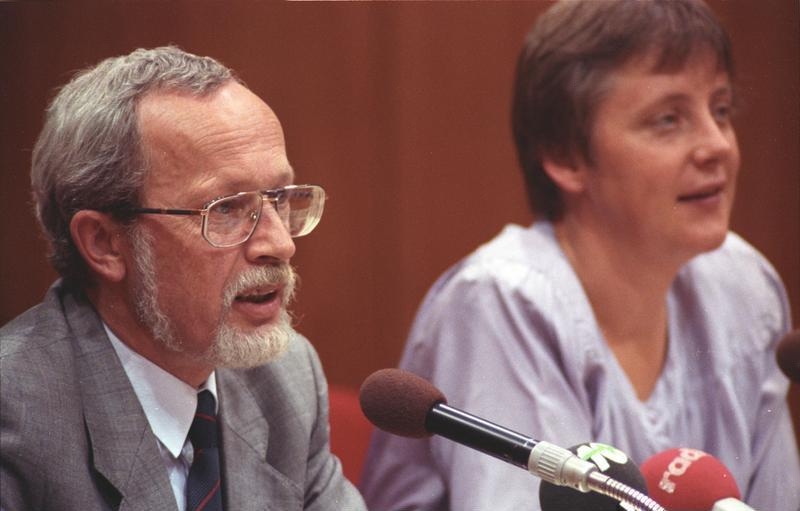 |
| Angela Merkel 1990 |
2. Vor dem Mauerfall hatte in Deutschland gerade das grösste Experiment der neueren Geschichte begonnen und Fahrt aufgenommen: der Umsturz der Sozialen Marktwirtschaft in eine deregulierte, privatisierte und steueroptimierte Liberale Marktwirtschaft. Die bittere Ironie der Geschichte war ja gerade, dass die Montagsdemonstranten vor der Wende in der DDR "Keine Experimente" skandiert hatten, weil sie keinen neuen "Dritten Weg" beschreiten, sondern einfach die Westliche Wirtschaftsordnung unverändert übernehmen wollten. Wie konnten sie ahnen, dass man im Westen gerade dabei war, die ersehnte Wirtschaftsordnung unzustürzen und damit ein gigantisches Experiment zu starten. Viele der impliziten Versprechen wie Verteilungs- und Steuergerechtigkeit, die während des Kalten Kriegs dem Kapitalismus abgerungen worden waren, wurden im Nachhall nach der Wende von den Liberalen aufgekündigt. Das konnte Bundeskanzlerin Merkel natürlich nicht wissen. Ihr ökonomischer Referenzpunkt wurde wie bei einem Hütchenspieler unter der Hand abgeändert.
3. Als Physikerin ist Bundeskanzlerin Merkel darauf konditioniert, dass Wissenschaftler eine Ahnung von ihrer Materie haben, und dass Lehrbücher den Stand des Wissens wahrheitsgemäss wiedergeben. Beides ist im Fall der Ökonomie nicht gegeben: Ökonomen haben wohl Ahnung von Ökonomie, aber keine Ahnung von Wirtschaft, und Lehrbücher, vor allem einführende Literatur, verfälschen oder ignorieren den Stand des Wissens (vor allem Tatsachen, die empirisch widerlegt wurden) und haben einen von Ökonomen durchaus unbestrittenen pro-Markt-Bias.
Diese teuflische Dreifaltigkeit von fehlender persönlicher Erfahrung, Täuschung über den wahren Charakter der eigentlich herbeigesehnten Wirtschaftsordnung (unterschobene Liberale statt erwünschte Soziale Marktwirtschaft) und schliesslich Täuschung über den wahren -- nämlich ideologischen -- Charakter der Wissenschaft Ökonomie, führt dazu, dass Bundeskanzlerin Merkel wirtschaftliche Massnahmen ergreift, die nicht funktionieren und immer weiter von einer gerechten, effizienten und krisenarmen Sozialen Marktwirtschaft wegführen.
Friday, January 2, 2015
On typical cost curves
I have written extensively about perfect competition and the fact that the claims associated with it cannot be proven scientifically. In fact, computer simulations of perfect competition show conclusively the same price and amounts as in a monopoly. I've also written about Joseph Stiglitz' explanation of why this might be a logical outcome of the theory.
There is a further point that I want to make, and that Hill and Myatt make in their excellent book The Economics Anti-Textbook. It is the point about the "typical cost curve" that underlies the theory of perfect competition.
For the theory to produce the results that economists claim, firms must be so small that they don't have market power: any change in production quota is too small as to affect market prices. The chief thing that guarantees their small sizes is the typical u-shaped average cost curve, because profit-maximising firms will stop producing when marginal cost of production equals the marginal revenue from sales. The problem is, that the typical u-shaped average cost curve is a total fabrication pulled out of thin air. What economists call "typical" is known at least since 1952 to have no factual base whatsoever.
In a survey by Wilford J. Eiteman and Glenn E. Guthrie in 1952 (published in The Shape of the Average Cost Curve, American Economic Review, 42.5: 832–838) managers of 334 companies were shown a number of different cost curves, and asked to specify which one best represented the company’s cost curve. A stunning 95% of managers responding to the survey chose cost curves with constant or falling costs. That leaves at most 5% for the "typical" u-shape.
A. S. Blinder, former vice chairman of the American Economics Association, conducted the same type of survey in 1998, which involved 200 US firms in a sample that should be representative of the US economy at large. He found that about 40% of firms reported falling variable or marginal cost, and 48.4% reported constant marginal/variable cost (Asking about Prices: A New Approach to Understanding Price Stickiness. Russell Sage Foundation, New York). A minority of about 11% of those surveyed reported the typical u-shape.
What does all this tell us? Economists know at least for 60 (that's sixty) years that the tale of u-shaped cost curves -- and as a consequence the majesty of perfect competition that rests heavily on this claim -- is a falsehood, yet it's still the staple of every economics textbook. Note that also the Wikipedia page linked above did not mention the fact that the claim has been empirically proven to be false, until I added it on January 3, 2015 (see page history).
The u-shaped cost curve is not a simplification either, because assuming a constant average cost would be much simpler. But then, constant average cost does not guarantee the firms to remain small, and hence perfect competition to work.
No, the typical u-shaped cost curve is a complete fabrication pulled out of thin air in order for the theory of perfect competition to yield the results that economists wish it to have but cannot produce otherwise. After all, who wants to know a truth that contradicts the dogma of perfect competition?
Now, how's that for a value-free and results-open science!
Update [28.12.2015]: I just noticed that the Wikipedia page that I edited (see above) has been modified to begin with the statement: "Some argue that cost curves are not typically U-shaped." If nothing else, this shows how insidiously economists misrepresent facts. Indeed, the statement "some argue that..." makes it seem as if the not-U-shaped cost curves are a position held by a minority of economists ("some") when what follows is actually real evidence. Not just "theory", but observations in the real world. Something that "some" people call science. I modified the article to state "Evidence shows that cost curves are not typically U-shaped." Let's see how long this modification lasts.
Saturday, August 9, 2014
The Myth of Perfect Competition
I have written extensively about the standard textbook claim that under perfect competition you'll get higher quantities at lower prices compared to a monopoly situation, and the strange fact that this proposition somehow cannot be reproduced in a computer simulation. Instead, the simulation consistently shows the same quantities at the same prices for perfect competition as for a monopoly. I am particularly interested in this result because in Switzerland later this year a referendum is being held on whether to abolish "competition" in the so-called health insurance market and install a government-run single payer monopoly instead. Of course, the claim that competition keeps quality up and prices down is heard everywhere. But apparently it cannot be scientifically shown to be true.
I've come across two explanations as to why the situation called perfect competition is unstable, and why therefore prices and quantities might converge to monopoly levels. Both of these start by asking what would happen if a firm chooses to demand a higher price than the equilibrium price at perfect competition. The theory claims that consumers would simply abandon such a supplier and fulfill their purchases elsewhere which in turn would discourage such a deviation. However, beyond mere assertions to that end the theory fails to show that this is indeed so.
Joseph Stiglitz, for example, says that the process of switching to a new supplier involves a certain cost (looking for a new supplier, driving farther, etc), and as long as the price increase is lower than the cost of switching, the consumer is better off if he remains with the supplier, despite the higher price.
This may be so, but there's a more serious problem with the theory (cf The Economics Anti-Textbook by Hill and Myatt): It is not certain at all, that the other suppliers are able or indeed willing to absorb these defecting customers. Economists, of course, will claim that because the firms are small, the number of defectors is small enough and thus easily absorbed by the remaining firms. But if the firms are small, it also implies that one or a few additional customers are being felt by those firms that receive them. The fact that firms are small cuts both ways. In any case, however, the firms are unable to absorb additional customers for a simple reason: they are already operating at the sweet spot where the production capacity is maximized and marginal cost equals marginal revenue. One additional unit produced and — because of the rising cost curve (remember?) — the firm incurs a loss. The firm has thus two options: refuse to serve the customer or raise the price, which, according to the theory, will drive away customers and hence inflate the number of defectors even further.
But consider what happens if only a single customer is willing to accept the higher price, e.g. because there is no place else to go: the firm serving this one customer will make a positive profit because it can successfully charge a price above marginal cost (remember that because MC = MR, all other firms make no profit at all). The theory implies that this cannot possibly happen as no customer would pay a higher price, given all the fabulous competition among firms. But at the same time it fails to show that the customer has any other place to turn to, and Stiglitz suggests that the customer may actually benefit from staying.
But this is not all: because all participants in perfect competition, firms included, have total knowledge, they all know that any small raise in price has the potential to lead to a positive profit because no other firm is able to absorb any possibly defecting customers. Therefore a few might stay. Remember that one single loyal customer is enough. Knowing all this, all firms — who are profit maximizing after all — will exhibit a tendency to increase prices just a little in order to exploit this non-negligible potential for profit. This tendency acts like an electromagnetic force between equally charged particles that will eventually drive prices away from the so-called equilibrium point towards the only real stable equilibrium price point: at monopoly level.
There you have it. The whole myth of perfect competition that rests on a completely fabricated assumption (of rising marginal costs) cannot be verified in a computer simulation. Instead, prices appear to converge at monopoly levels even for hundreds of thousands of profit-maximizing and non-colluding firms that compete in a market. Furthermore, a plausible story exists that explains why this is indeed a possible or even likely outcome given all assumptions presented. Will any of this change any debate anywhere on this planet about markets vs state-run monopolies?
Take a guess.
Monday, July 28, 2014
The Science of Economics
I often get some heat when I make the claim that economics isn't science. Science is not a field of study but a method of study, they say, which is sort of true. Alright then, let's be more precise.
Economics is the scientific study of "the economy" in the same way that theology is the scientific study of God.
Theology is a very peculiar kind of science, because the object of study — God — does not reveal himself to those that engage in the studying. Nobody has ever interviewed God. Nobody has even seen him or can prove his very existence, so nobody can know what God really thinks or wants (not that this fact stops some people from acting as if they did). Now, of course, you can still do science and study revelation and religious practice and rituals using the historic texts (e.g. the Bible), but you will only learn what people thought God wanted, what people believed, and what people did to share that belief — even with people that didn't care. So the study of God (the literal meaning of "theology") is not so much about God but about the people who do the studying. So it's really like doing alien research, for example by interviewing people who claim to have been visited or abducted by aliens. Here again, through these interviews will learn absolutely nothing about aliens. You will only learn about the people (and the minds of those) that make these alien claims.
In the same way that theology (or alien research) is not the scientific study of God (or aliens), economics is not the scientific study of the economy. Now, in contrast to (earth-visiting) aliens there is an economy to study, but the science of economics does not care about the real thing. As I've shown in an earlier post: when confronted with facts in the real economy that contradict claims in their economic theory they dismiss the former by saying that you needn't bother with facts as they don't matter. Only economic theory does. In the words of David Stockman: "People will never agree about the facts, but it's logical..." (Here's the video. The quote is at 7'30").
There is ample literature that shows that the science of economics distorts inconvenient facts in their textbooks (1), replaces hypotheses that are both plausible and empirically observable by other hypotheses that are neither (2), but that just so happen preserve the desired ideological properties of the economy (e.g. equilibrium), or simply makes stuff up and presents it a logically derived theory (3).
Here are a few books that prove all the above claims, and much more. I can only recommend that everybody who cares about the well-being of the economy in general or the middle class in particular reads some (or all) of these books to inoculate oneself against the nonsense that is economic "theory"
- The Economics Anti-Textbook by Rod Hill and Tony Myatt
This book serves both to teach and debunk microeconomics. Each section starts with a summary of the theory as presented in a textbook, and then proceeds to show where ideological bias, logical inconsistency or simply empirically unfounded invention taints, distorts or invalidates the theory. Hill and Myatt don't always disprove the theory but show convincingly that more plausible alternatives exist. Helpful questions for your professor allow economics students to probe their teacher's openness to reasoned debate. - Zombie Economics by John Quiggin
Quiggin's book is particularly enlightening about economics' unwillingness to accept empirical evidence. Analyzing the most important factors that led the world into the financial crisis of 2007 he shows a) how these theories contributed to the crisis, b) how the crisis disproved important claims of these theories, but most importantly c) how the economics profession keeps defending these refuted claims tooth and nail, despite all the evidence that the crisis piled on their doorstep. - Economics for the Rest of Us by Moshe Adler
Adler does not actually debunk any of the theories he's discussing in the book, but he shows that they were conscious choices by economists in the face of better, more plausible theories because they had ideological bias against these theories or any of their (sometimes distant) implications.
Saturday, June 28, 2014
My Music Blog
Sometimes you need some time off, especially if you're writing about mainstream economics. There's only so much inconsistency, illogicality or ideology that you can take at any one time. I for one need a valve to vent off, and in my case that's music. I own a Yamaha MOX6 and a small collection of home-made analog synthesizers and use them to produce music, or just tickle the ivories, as the saying goes.
I have several songs in the pipeline in various stages of completion, and will be publishing them as soon as I deem them finished. If you like music, and enjoy a few minutes off my rants on economics, you're welcome to take a look at my music blog YoshiMusix and/or my YoshiMusix channel on YouTube where I also occasionally present one or the other of my do-it-yourself electronics projects.
And now back to business!
Subscribe to:
Posts (Atom)